
A light guide rod is an optical component designed to transmit and redistribute light along a long, narrow structure. When light from an LED enters the light guide rod, it travels through the rod while the optical design controls how the light is distributed, transforming a concentrated LED point source into a continuous and uniform line of light.
Light guide rods can be used in a wide range of applications, including scanners, printers, document and banknote recognition systems, human-machine interfaces (HMI), home appliances, industrial equipment, automotive lighting, and various types of indicator lighting. Whenever a product requires a local light source to be converted into a long, linear illumination area, a light guide rod can be considered as part of the optical design.
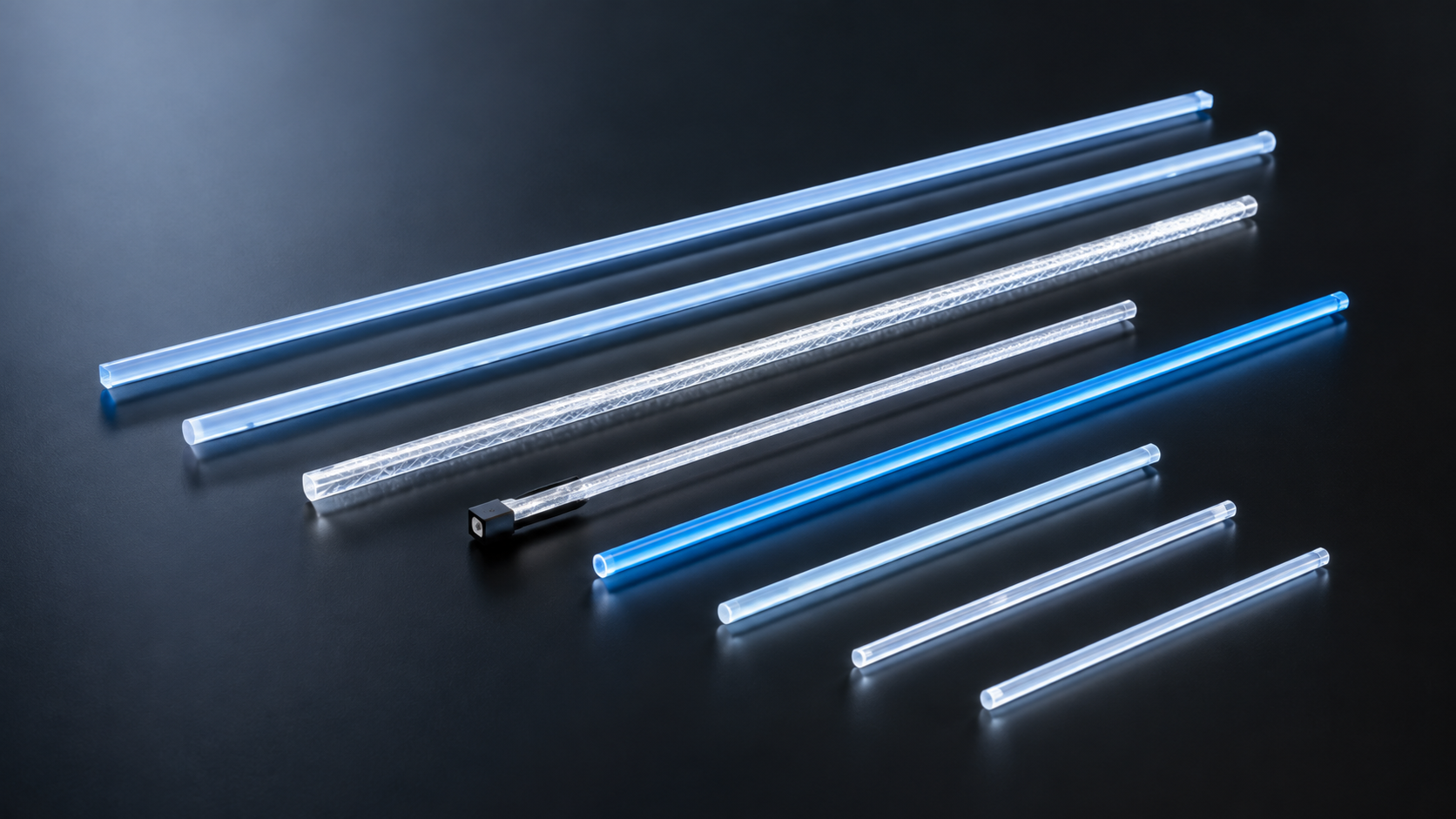
PMMA light guide rods for linear lighting applications.
What Is a Light Guide Rod?
A light guide rod is typically made from an optical material with high light transmission, such as acrylic (PMMA). The rod itself does not generate light. Instead, it receives light from an LED or another light source and guides that light along its length.
After entering from the end or another designated input area, light travels through the material. Optical teeth or microstructures on the surface are then used to control the light distribution, allowing more light to reach areas farther away from the LED. This helps reduce excessive brightness near the light source and insufficient brightness at the far end, resulting in a more uniform line of light along the rod.
This controlled light distribution is one of the key differences between an optical light guide rod and an ordinary transparent plastic rod.
LED point source → Light enters the rod → Light is transmitted and redistributed along the rod → Continuous, uniform linear light
YONGTEK provides PMMA round and square light guide rods and can develop customized optical tooth patterns according to the optical requirements of each application. If you are developing a linear lighting product, you can provide us with your dimensions, drawings, or initial design concept and contact us to discuss a customized light guide rod solution.
Why Convert an LED Point Source into Linear Light?
LEDs are compact, efficient, and easy to integrate into product designs. However, the light from an individual LED is naturally concentrated around a relatively small area.
When a product requires a long illuminated section, simply arranging multiple LEDs along the structure can result in visible individual light points, or hot spots, due to the spacing between the LEDs. This can make the illuminated area appear uneven.
Adding more LEDs and reducing the spacing between them can help improve uniformity, but this approach is not suitable for every product. More LEDs also mean additional PCB space, circuit routing, light source positioning, mechanical design considerations, and cost. This becomes especially important in narrow, slim, or space-constrained products where LEDs cannot be installed directly behind the entire illuminated area.
A light guide rod provides another approach: light from one or more local LED sources is coupled into a long optical element, transmitted along the rod, and redistributed so that light can gradually exit along the required illumination area.
What Problems Can a Light Guide Rod Help Solve?
| Common Design Challenge | Light Guide Rod Design Approach |
|---|---|
| Visible LED hot spots | Redistribute local LED light along the length of the rod to reduce visible point sources |
| Uneven brightness along the illuminated area | Use surface microstructures to control light distribution at different positions |
| A long illuminated area requires many LEDs | Evaluate end-lighting or other configurations according to length and brightness requirements |
| LEDs cannot be installed directly at the illuminated area | Guide light from the LED location to the required illumination area |
The main purpose of a light guide rod is therefore to transmit and redistribute concentrated LED light along a long structure to create a continuous and uniform line of light.
This makes light guide rods suitable for both functional and visual lighting. Scanners, document readers, and optical recognition equipment may require stable linear illumination, while HMI systems, appliance indicators, and automotive interiors may use continuous linear light for status indication or visual effects.
How Does a Light Guide Rod Work?
The working principle of a light guide rod can be divided into three stages: light coupling, light transmission, and light extraction.
1. Light Coupling: Directing LED Light into the Rod
Light from the LED first enters the transparent optical material through the end of the rod or another designated coupling area. The position of the LED, distance from the rod, and coupling configuration can all affect how much light enters the light guide and how it behaves afterward.
2. Light Transmission: Guiding Light through the Rod
Once light enters the light guide rod, part of it travels through the material by total internal reflection.
Total internal reflection is an important principle in optical light guides. When light travels from a material with a higher refractive index toward a medium with a lower refractive index and the incident angle meets the required conditions, the light is reflected back into the material rather than passing directly through the surface.
This allows LED light to continue traveling along the length of the light guide rod.
3. Light Extraction: Controlling Light Distribution with Surface Microstructures
If the surface of a light guide rod were completely smooth, much of the light could continue traveling inside the rod through total internal reflection until it reached the opposite end or encountered a structure that changed its optical path. This would make it difficult to extract the required amount of light evenly along the entire rod.
To allow light to exit at controlled positions, optical teeth or microstructures can be created on the surface of the rod. These structures alter the original propagation path of part of the light and control where and how much light is emitted.
A properly designed microstructure can reduce excessive light extraction close to the LED, allowing more optical energy to continue traveling toward the far end before gradually being extracted.
By adjusting the surface structure at different positions along the rod, light can travel farther while reducing the difference between bright areas near the LED and darker areas farther away. This helps improve overall illumination uniformity.
LED point source → Light coupling → Internal light transmission → Surface microstructures control distribution and extraction → Light travels toward the far end and is gradually extracted → Uniform linear light
What Factors Affect Light Guide Rod Uniformity?
Adding surface microstructures alone does not automatically guarantee perfectly uniform illumination.
Areas close to the LED generally receive more optical energy, while the available light changes as it travels along the rod. The optical design therefore needs to be adjusted according to the guiding distance, product geometry, and required light distribution.
- Light guide length
- Rod geometry, such as straight or curved designs
- LED specifications, quantity, and position
- Single-end or dual-end light input
- Optical tooth pattern and surface microstructure design
As a result, even light guide rods made from the same material may require different optical designs depending on their length, shape, and LED configuration.
Light Guide Rod vs. Light Guide Plate vs. Light Guide Film
Light guide rods, light guide plates, and light guide films are all optical light-guiding components, but they are designed for different light patterns, structures, and product requirements.
A simple way to determine which solution to evaluate is to first identify whether the product requires linear light, area illumination, or an ultra-thin area-lighting structure.
| Comparison | Light Guide Rod | Light Guide Plate | Light Guide Film |
|---|---|---|---|
| Primary Light Pattern | Linear light | Area illumination | Ultra-thin area illumination |
| Typical Structure | Round or square rod | Flat plate | Thin film |
| Main Function | Convert a point source into uniform linear light | Distribute edge lighting across a larger surface | Create area illumination in a thin structure |
| Typical Applications | Linear lighting, reading illumination, indicators | Display backlights, panel lights, surface lighting, exit signs, emergency lighting | Ultra-thin displays, illuminated cards, status indicators, illuminated buttons, illuminated keyboards |
If your product requires a long and narrow illuminated area, a light guide rod may be the first option to evaluate. If an entire surface needs to be illuminated uniformly, a light guide plate may be more suitable. For applications where thickness and available installation space are especially limited, a light guide film can also be considered.
What Are the Common Applications of Light Guide Rods?
Light guide rods can be considered whenever a product needs to convert a local LED point source into a longer, continuous, and more uniform line of light.
Common applications include document scanning and reading, printing equipment, banknote recognition, optical document reading, human-machine interfaces, equipment indicators, various status lights, and automotive lighting.
Common Light Guide Rod Applications
| Application | Typical Equipment | Function of the Light Guide Rod |
|---|---|---|
| Document Scanning & Reading | Scanners, multifunction printers, fax machines | Provide long, narrow illumination for document reading |
| Printing Equipment | Laser printers | Provide linear illumination for specific internal functions |
| Banknote & Financial Recognition | Banknote recognition equipment | Provide illumination for banknote and document recognition |
| Optical Mark & Document Reading | Optical mark readers | Provide linear illumination across the reading area |
| HMI & Equipment Indicators | Industrial equipment, appliances, robots, indicator lights | Status indication, operating indicators, and linear illumination |
| Automotive & Transportation Lighting | Interior ambient lighting, linear light features | Create continuous decorative linear illumination |
Scanners and Document Reading Equipment
When scanning a document, the system needs to illuminate a long, narrow area before the image sensor receives the light reflected from the document.
A linear light guide can distribute LED light from an end or designated input position along the reading direction, creating a longer and more uniform illumination area. Light guide rods are used in applications such as contact image sensors (CIS), scanners, multifunction printers, and high-speed document scanning equipment.
For these systems, brightness alone is not enough. The light distribution across the entire reading area must also be stable, uniform, and suitable for the sensing requirements.
Printing Equipment
Scanning and printing functions are often integrated into the same multifunction device, but the role of a light guide rod can be different in each system.
Scanner modules primarily require document illumination. In some laser printing systems, linear light guide components may also be used to provide illumination for specific functions such as photoconductor drum charge erasing.
Therefore, even when light guide rods are used in both types of equipment, the required length, LED configuration, and surface microstructure need to be designed according to the specific function.
Banknote Recognition and Optical Reading Equipment
Banknote recognition systems use light sources and sensors to read optical features on banknotes. These systems may therefore require a long, evenly illuminated reading area.
Light guide rods are used in banknote recognition applications. However, different systems may use different light sources, wavelengths, sensing methods, and illumination structures, so the optical design must be evaluated according to the actual recognition method and system requirements.
Optical Mark and Document Reading Equipment
Equipment used to read answer sheets, forms, or other optically marked documents also requires stable illumination across the reading area.
A linear light guide can help distribute LED light along the required reading width. During product development, factors such as reading width, LED position, sensor configuration, available installation space, and required illumination uniformity should all be considered.
HMI, Home Appliances, and Industrial Equipment
Beyond optical reading systems, light guide rods can also be used for equipment status indication and visual guidance.
For example, when an LED mounted on a PCB cannot be positioned directly behind the visible illuminated area because of mechanical constraints, a light guide can transmit the light to the required location.
Products that require long status lights, contour lighting, indicator lights, or continuous linear illumination can also benefit from light guide rod designs. In industrial equipment, HMI systems, home appliances, and robotics, linear lighting can therefore provide both visual styling and functional information such as operating status, warnings, or user guidance.
Automotive and Transportation Lighting
Door trim lighting, interior ambient lighting, daytime running lights, and tail lamps may all require concentrated LED point sources to be transformed into continuous and uniform linear illumination.
YONGTEK offers automotive light guide rods and light guides and can discuss customized round rods, square rods, and optical tooth patterns according to individual product requirements.
For automotive applications requiring a larger illuminated surface rather than a narrow line of light, other light guide structures can also be evaluated according to the product design.
Light Guide Rod FAQ
Below are some of the most common questions about light guide rod selection and product development, including differences from light guide plates, illumination uniformity, guiding distance, and curved designs.
Custom Light Guide Rods and Linear Light Guide Design
YONGTEK provides PMMA round and square light guide rods. Since every product has different requirements for guiding distance, geometry, LED configuration, brightness, and illumination uniformity, the optical design should be evaluated according to the actual application.
If you are developing a scanner, optical recognition system, HMI device, home appliance, industrial equipment, automotive lighting product, or another application requiring linear light guidance, send us your dimensions, drawings, and optical requirements. YONGTEK can work with you to evaluate a suitable light guide rod design.
Contact YONGTEK