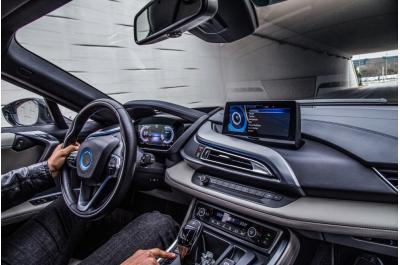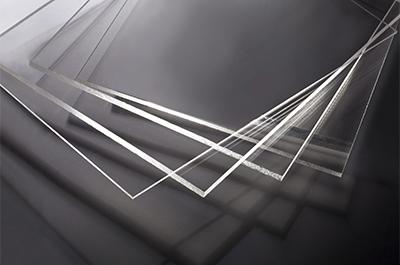

An automotive display cover lens does more than protect a center display, digital instrument cluster, passenger display, or other in-vehicle screen. The way the cover material behaves after an impact can also affect occupant safety, making post-impact condition an important part of material selection.
One common solution is to laminate an automotive anti-shatter film to the cover glass so that, if the glass breaks, fragments are less likely to scatter toward the driver or passengers. Another option is to replace the glass-and-film stack with a PMMA/PC composite cover lens, reducing the risk associated with brittle glass fracture and sharp fragments at the material level.
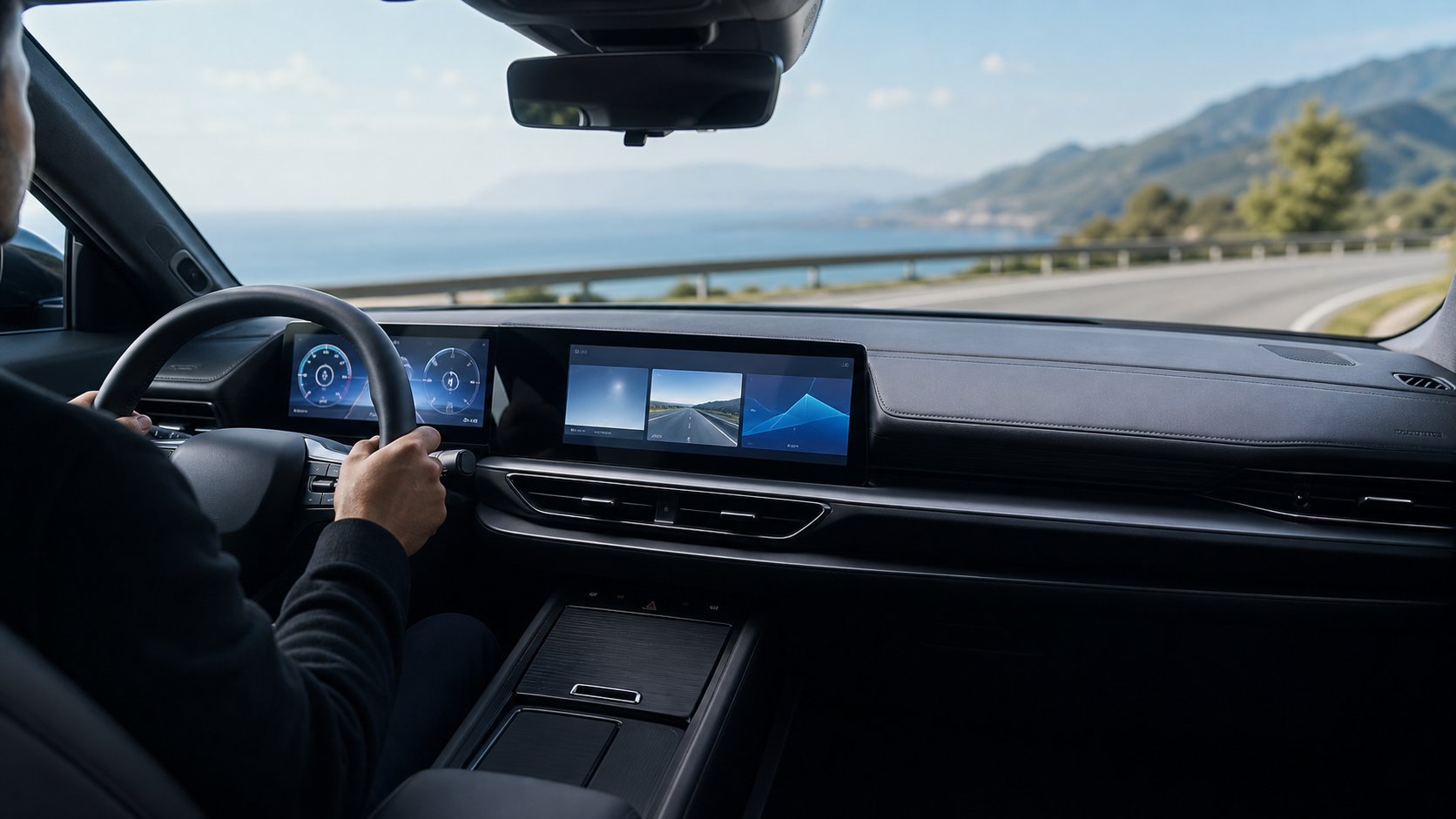
An automotive display cover lens must balance display protection, cockpit design, and occupant safety after impact.
What Should You Consider When Selecting an Automotive Display Cover Lens?
The cover lens is the outermost surface of the display—the part drivers and passengers see and touch. In addition to protecting the display panel and touch structure beneath it, the cover must work with the visual design of the instrument panel, center console, and surrounding cockpit trim.
Automotive display cover-lens development typically needs to address the following:
- How the cover material behaves after impact
- Occupant safety if the cover breaks or is damaged
- Flat, curved, or free-form geometry
- Hard-coat, anti-glare, anti-reflection, and anti-fingerprint requirements
- Printing, cutting, forming, and lamination methods
- Customer-specified safety and reliability validation
Why Does Cover Glass Need an Anti-Shatter Film?
Glass offers a flat surface and a premium appearance, which is why it is widely used as the outer cover for automotive displays. It can still break, however, when subjected to an impact beyond its design limits.
Because automotive displays sit close to occupants, engineers must consider more than whether the glass might be damaged. They also need to assess whether fragments could detach or scatter after breakage. Laminating an anti-shatter film to the cover glass helps retain those fragments and keeps the post-breakage condition more controlled.
An anti-shatter film does not make glass unbreakable. Its role is to reduce the risk of fragments scattering after the glass has broken. That is the key difference between an anti-shatter film and a conventional screen protector.
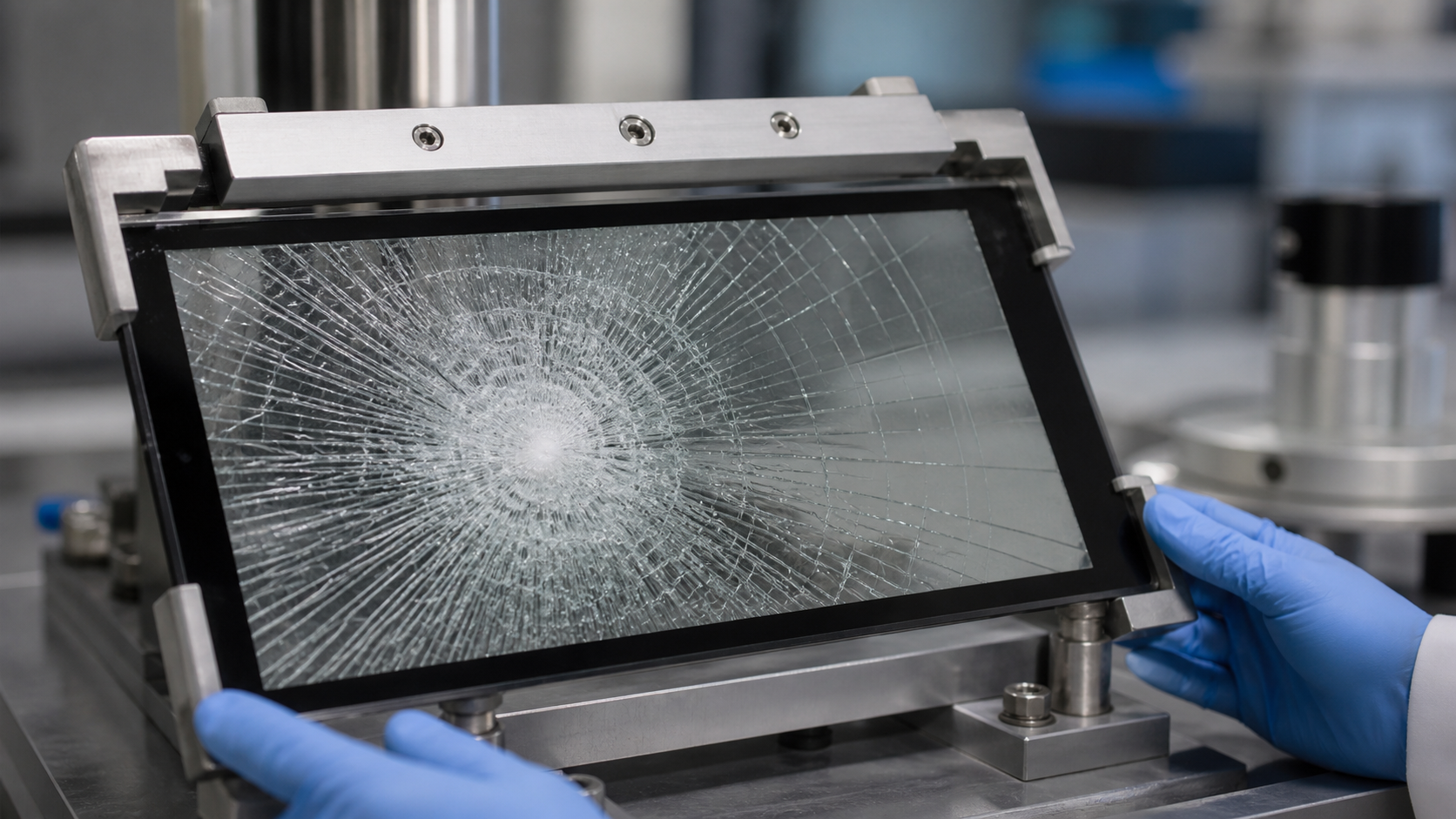
The purpose of an anti-shatter film is to keep broken glass fragments in a more controlled state.
Extended Reading: Anti-Shatter Film for Automotive and Industrial Displays
Learn more about fragment retention, surface-treatment options, and applications in automotive displays.
How Can Anti-Shatter Film Combine Fragment Retention with Optical Surface Functions?
In addition to retaining glass fragments, an anti-shatter film can incorporate hard-coat, anti-glare, anti-reflection, and anti-fingerprint treatments to meet different project requirements.
HC hard coat: Improves scratch resistance at the film surface.
AG treatment: Reduces glare caused by external light.
AR treatment: Lowers surface reflections that can interfere with display readability.
AF treatment: Helps reduce the adhesion of fingerprints and smudges.
Coextruded PMMA/PC Sheet: An Alternative Cover-Lens Material
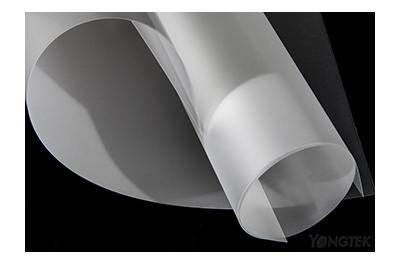
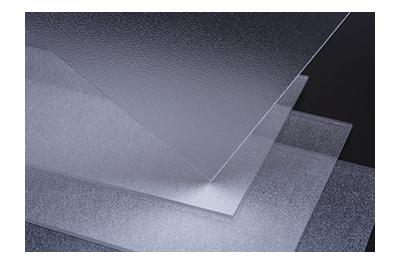
A PMMA/PC composite sheet is made by coextruding a PMMA surface layer with a PC substrate into a single structure. The PMMA layer contributes surface hardness, weather resistance, and optical appearance, while the PC substrate provides impact resistance.
By combining the strengths of both materials, the sheet can be processed into an automotive display cover lens. Under impact, it does not fracture into the sharp, brittle pieces associated with glass. It is also lighter than a conventional glass solution, making it an option worth considering for new display designs.
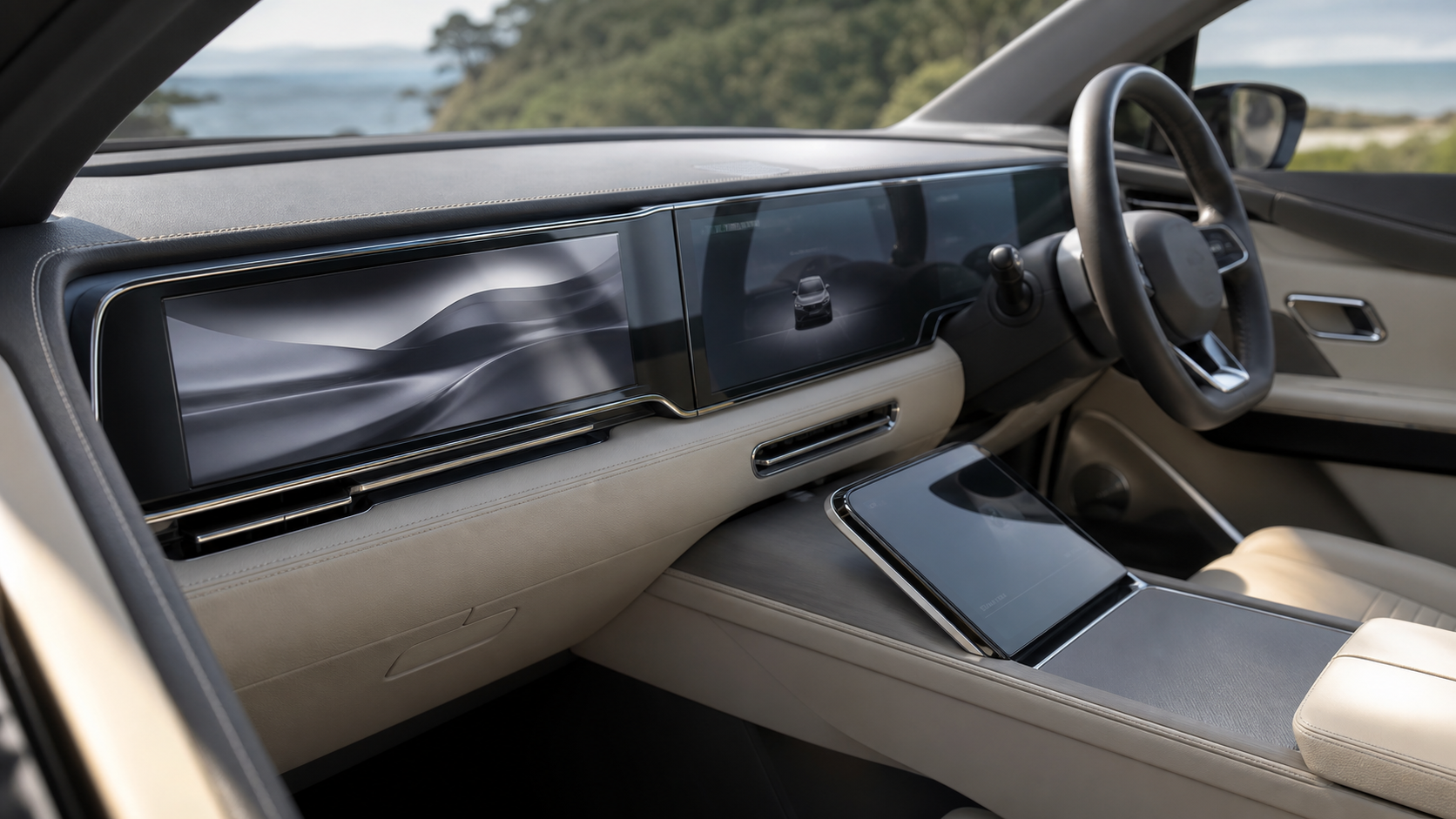
A PMMA/PC composite cover lens can support curved displays and integrated cockpit designs.
Extended Reading: PMMA/PC Composite Sheet
Learn more about the composite structure, surface-treatment options, and custom processing.
Can a PMMA/PC Composite Cover Lens Replace Glass and Anti-Shatter Film?
A PMMA/PC composite does not form the sharp fragments associated with brittle glass breakage, so it can reduce the need for an additional anti-shatter film.
How Does a PMMA/PC Composite Cover Lens Reduce Display Weight?
At the same dimensions and thickness, a PMMA/PC composite cover lens weighs approximately half as much as glass. For large center displays, wide-format screens, or multi-display cockpits, a lighter cover can help reduce overall weight.
Why Is PMMA/PC Composite Better Suited to Curved and Free-Form Cover Lenses?
Automotive displays are moving beyond flat rectangles toward curved surfaces, wide formats, and free-form outlines. When the cover lens must follow the instrument panel, center console, or cockpit trim to create an integrated appearance, the material's forming and processing flexibility directly affects design feasibility.
Compared with glass, PMMA/PC composite material is easier to form into curved surfaces and machine into non-standard outlines. YONGTEK can process the sheet into curved and free-form automotive display cover lenses, with precision cutting, drilling, chamfering, printing, and surface treatments evaluated according to project requirements.
Feasible dimensions, thickness, curvature, and geometry must still be confirmed against the selected material and product drawing. Greater processing flexibility does not mean every shape is free of manufacturing constraints, so feasibility should be discussed early in the design stage.
Extended Reading: Composite Cover Lenses for Automotive Displays
Review the options available for curved forming, free-form processing, printing, and surface treatments.
Cover Glass with Anti-Shatter Film vs. PMMA/PC Composite: How to Choose
Neither solution is inherently better. Each suits different automotive display requirements, so the advantages and trade-offs below can help guide material selection.
| Comparison | Cover glass with anti-shatter film | PMMA/PC composite cover lens |
|---|---|---|
| Cover structure | A stack comprising glass, film, and an adhesive layer | A coextruded structure combining a PMMA surface layer with a PC substrate |
| Weight | Heavier | Approximately half the weight of glass at the same dimensions and thickness |
| Curved and free-form processing | Less suitable for more complex geometries | Greater flexibility for curved forming and free-form processing |
| Surface treatments | Available, although surface treatment on curved designs may have a comparatively lower processing yield | Available, with a high processing yield |
| Suitable applications | Projects that specify a glass appearance or retain an established glass structure | Projects prioritizing impact resistance, lower weight, and design flexibility |
If the project already uses a proven glass cover design, start by evaluating the anti-shatter film and required surface functions. For a newly developed automotive display, consider a PMMA/PC composite cover lens during the early material-selection stage.
Choosing the Right Cover-Lens Solution for Your Automotive Display
Automotive display safety involves more than everyday scratch resistance and image quality. It also requires careful consideration of how the cover material behaves after impact.
Cover glass with an anti-shatter film uses the film to manage fragments after the glass breaks. A PMMA/PC composite cover lens addresses the issue at the material level by reducing the risks of brittle glass fracture and sharp fragments, while also offering lower weight and more flexibility for curved designs.
If you are developing a center display, digital instrument cluster, passenger display, or another smart-cockpit product, prepare the cover dimensions, thickness, geometry drawings, bonding structure, required surface functions, validation conditions, and forecast quantity. Send these details through YONGTEK's automotive display cover-lens and anti-shatter film inquiry page to discuss suitable materials, processing methods, and sample evaluation.
Frequently Asked Questions About Automotive Display Cover Lenses
Can Anti-Shatter Film Prevent Cover Glass from Breaking?
No. Its primary function is to retain fragments after the glass breaks and reduce the risk of pieces detaching or scattering. It does not guarantee that the glass will withstand every impact.
How Is Anti-Shatter Film Different from a Standard Screen Protector?
Anti-shatter film focuses on controlling fragments after glass breakage. A standard screen protector is mainly intended for everyday scratch resistance, fingerprint reduction, or general surface protection. The two may share certain surface-coating functions, but they serve different purposes.
Which Surface Functions Can Be Added to Anti-Shatter Film?
Depending on the project, anti-shatter film can incorporate a hard coat as well as anti-glare, anti-reflection, and anti-fingerprint treatments.
Does a PMMA/PC Composite Cover Lens Always Eliminate the Need for Anti-Shatter Film?
Not necessarily. Because PMMA/PC composite does not form the sharp fragments associated with brittle glass breakage, it can reduce the need for an additional anti-shatter film.
Is a Composite Cover Lens Always Half the Weight of Glass?
At the same dimensions and thickness, the material weighs approximately half as much as glass.
Is PMMA/PC Composite Suitable for Curved Automotive Displays?
PMMA/PC composite offers good forming and design flexibility for curved and free-form cover lenses. Feasible curvature, dimensions, thickness, processing methods, and surface treatments must still be confirmed against the product drawing and project requirements.
Discuss Your Automotive Display Cover-Lens Project with YONGTEK
If you are developing a center display, digital instrument cluster, passenger display, or another automotive display product, prepare the cover dimensions, thickness, geometry drawings, bonding structure, required surface functions, validation conditions, and forecast quantity. Contact YONGTEK to discuss whether cover glass with anti-shatter film or a PMMA/PC composite cover lens is better suited to your design, processing, and sample-evaluation requirements.